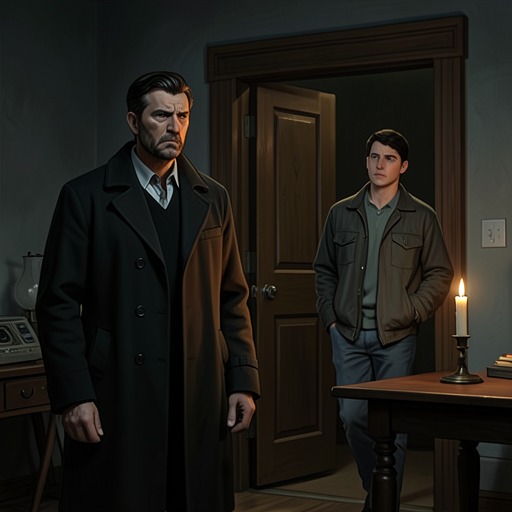
Disguise and Role-Playing
The Pale Blue EyeDisguise and role-playing are recurring means by which characters cross boundaries of identity and authority. A costume can conceal a familiar person, lend apparent legitimacy to an invented identity, or leave behind material clues that an investigator can read only cautiously. The novel makes recognition a staged process: observers first encounter clothing and manner, then revise their judgment when a face, a garment’s detail, or a discrepancy in testimony reveals what the performance has hidden.
Forms of Disguise
The disguises range from a complete change of outward appearance to the selective performance of an official role. Clothing is especially consequential in the military setting, where a uniform signifies authority as well as identity. A missing or altered insignia can therefore complicate recognition rather than settle it. Accent, facial hair, and a claimed name add further layers: a character may appear not merely to be someone else, but to belong to a different rank or background.
The narrative also distinguishes between disguise as a deliberate practical act and the less certain performance of a social or institutional role. A soldier’s deference, a witness’s silence, or an officer’s appearance may be observed, but these details do not by themselves establish deception. That uncertainty matters to the investigation: evidence of concealment must be separated from evidence that merely invites suspicion.
Lea Marquis as the Coachman
When a coachman arrives to fetch Edgar Allan Poe from his quarters, his elaborate clothes make him seem an eccentric stranger. He wears a dark green coat with scarlet lining and silver decoration, scarlet waistcoat and breeches, and a beaver-skin hat. Poe initially has no reason to know who has sent for him, and the visitor does not explain the destination. Instead, the disguised figure beckons without answering his demand for information.
The disguise is dismantled piece by piece. The coachman removes his gloves and hat and peels away the false mustache; the apparent stranger is revealed as Lea Marquis. Poe’s recognition reverses the scene’s first impression: the costume that had made the visitor seem unfamiliar had been concealing someone he knew. The reveal depends on visible actions rather than an explanation, turning removal of the disguise into the means of identification.
Lea’s role as coachman has a practical effect: it allows her to reach Poe and draw him into the waiting sleigh. The episode presents impersonation as a way to move through a world in which identity is ordinarily inferred from dress and assigned roles. At the same time, the scene keeps the method legible. The costume does not permanently erase Lea’s identity; once its elements are removed, the familiar person becomes recognizable again.
Uniforms as Evidence
Disguise also shapes the investigation through the discovery of an officer’s uniform. In a dark space, Augustus Landor finds the garment on a wooden hanger and brings it down for examination. Its blue pantaloons and coatee carry gold trim, but the shoulder bears a faint rectangle where a bar had been sewn. The missing insignia makes the garment evidence of an altered presentation of rank, not straightforward proof of who wore it.
Landor connects the uniform to the unidentified officer who had ordered Private Cochrane to leave Leroy Fry’s body. That association gives the garment investigative significance, but it remains a connection made by Landor, not an identification established by the clothing alone. He also notices a small raised patch above the waist, with a faintly sticky, rough surface. The scene ends as he is examining this detail and hears a footfall; the evidence is discovered in an interruption, before its meaning can be resolved.
The uniform’s altered shoulder shows how role-playing can leave traces. A bar once marked the garment’s rank; its removal suggests that the appearance of authority could be modified. Yet the text withholds a final conclusion about the wearer at this point. The uniform sharpens the question of identity while preserving the distinction between a clue and a proven identity.
Poe at Gouverneur Kemble’s Gathering
At Gouverneur Kemble’s house, Poe appears in the uniform of the late Joshua Marquis and passes himself off as Lieutenant Henri le Rennet. From a distance, Landor can make out only that the arriving figure is an Army officer; the face is turned away, and no clear rank is visible. When a lantern illuminates him, Landor recognizes Poe beneath the false clothes and facial adornments.
Poe’s transformation combines several signals of identity. He wears Joshua Marquis’s uniform, now marked on the shoulder with a single yellow bar, adopts a slight accent, and uses a horsehair mustache attached above his lip. Lea introduces him to Kemble as Henri le Rennet, and Poe responds in character. The invented identity thus gains credibility through coordinated costume, grooming, speech, and another person’s introduction—not through clothing alone.
The masquerade also makes recognition dependent on the observer’s knowledge. Landor knows the officers at West Point and initially takes pride in identifying them before they identify him, but this figure resists that familiar process until the lantern reveals Poe’s face. The scene complicates Landor’s confidence: the uniform supplies a plausible category, while concealment delays the person-specific recognition that would correct it. Poe’s disguise succeeds as an entrance into the gathering, even as Landor’s recognition exposes its constructed nature to the reader.
Recognition and Its Limits
Across these episodes, appearance operates as both instrument and uncertain evidence. Lea’s costume conceals a known identity until its components are removed; Poe’s uniform and assumed foreign identity create a new public one; the altered officer’s uniform points toward an earlier act without conclusively identifying its wearer. Each case asks observers to interpret visible signs in context rather than accept them at face value.
The novel’s treatment of role-playing is therefore connected to the mechanics of investigation. A uniform can imply authority, but a missing bar can unsettle that implication; a name can be supplied by a companion, but the introduction remains part of the performance; a witness may respond with military compliance without thereby resolving what happened. Disguise produces access and confusion at once. Recognition, when it comes, is not simply the recovery of a hidden face: it is a reassessment of what the costume, rank, and accompanying behavior had led others to believe.